


What is Payday Super?
The Australian Government has passed new laws changing the rules for when employers must pay workers’ superannuation contributions.
From 1 July 2026, all Australian employers will be required to pay their employees’ super at the same time as each payday, rather than quarterly. This is also known as the ‘QE day’, that is, the day you pay qualifying earnings, or QE, to your employees.
This change is known as Payday Super.
A contribution is on time if it is received by your employee’s super fund (with all the necessary information to allocate the contribution to the employee’s member account) within 7 business days after paying your employee. If you use a commercial clearing house, allow enough time for them to process your payment.
The payment deadline is extended, however, for the first eligible SG contribution you are making:
- for a new employee
- to a new complying super fund for an existing employee after you have stopped making contributions to another super fund.
In these situations, the contribution must be received by the super fund within 20 business days after the relevant QE day.
Why Payday Super is important.
Payday Super offers better retirement outcomes, because more frequent payments mean super balances grow faster through more regular compounding.
And for employers, compliance issues are reduced as smaller, more regular payments lower the risk of large unpaid super bills building up.
What employers need to do.
Payday Super starts on 1 July 2026 and applies to all employees, including full-time, part-time, and casual staff. It replaces the current quarterly Super Guarantee (SG) payment schedule.
Employers should start preparing now. This change may impact payroll timing, cash flow planning, and HR processes. Super Guarantee (SG) contributions must be paid on or before each Payday. Payment must be made through SuperStream compliant payroll software or a superannuation clearing house. Employers currently using the ATO Small Business Superannuation Clearing House should note that this service is expected to close by 1 July 2026, so an alternative solution will be required. Your Australian Food Super Client Services Manager can assist you with this.
How to Prepare for Payday Super




Checklist: Are you ready for Payday Super?
- Payroll software updated for Payday Super
- Pay cycles reviewed (weekly/fortnightly/monthly)
- Automated super payments enabled
- Cash flow adjusted for more frequent payments
- Employee super fund details verified
- HR/payroll staff trained in new requirements
- Updated onboarding processes for new employees
- Record-keeping procedures compliant
- Communication sent to employees
- Tested a mock pay cycle to ensure timing and accuracy
- If you’re an existing registered user of the Small Business Superannuation Clearing House, you need to:
Frequently Asked Questions (FAQ)
What does QE mean?
From 1 July 2026. the Super Guarantee (SG) amount is calculated as 12% of qualifying earnings (QE). QE includes Ordinary Time Earnings (OTE), salary sacrifice contributions and other amounts that are currently included in an employee’s salary or wages for Super Guarantee.
That’s a change from the current situation where the SG amount is calculated as 12% of OTE.
Do I still need to lodge anything quarterly?
No. Super must be paid each Payday, but you may still need to report through Single Touch Payroll (STP), which your payroll software will handle.
What if I pay employees weekly?
You must also pay their super weekly. Payday Super matches your existing pay cycle.
Does this apply to casual staff?
Yes. All employees, including casuals and seasonal workers in the food industry, are covered.
Do contractors count?
If your contractors are considered employees for super purposes (e.g., paid mainly for their labour), you must pay their super every payday.
Can I continue paying super quarterly?
No. Quarterly payments will no longer meet legal requirements from 1 July 2026.
What happens if I accidentally pay late?
Even a single day late may trigger the Super Guarantee Charge, which is significantly more costly than the original super contribution.
Will software providers support this change?
Yes. Most modern payroll platforms (e.g., Xero, MYOB, QuickBooks, Deputy-integrated systems) are preparing updates now. You should confirm this with your provider.
Are the SuperStream data and payments standards affected by this new legislation?
Yes. To help employers and intermediaries meet the new deadlines, the SuperStream data and payment standards will be revised to:
- allow near real-time payments through the New Payments Platform
- improve error messaging so you can address errors faster
- provide a new member verification request, which enables employers to confirm that a super fund can match their employee contribution to the super fund for the first time and will accept a contribution for them.
- Improvements to the Fund Validation Service will also give employers early notice of key changes to large super fund’s details, such as fund mergers, that could affect their ability to make contributions to super funds.
Need more information?
For more information about Payday Super
- Visit the ATO website, or
- Contact your Australian Food Super Client Services Manager.
- View the ATOs Payday Super is here video:

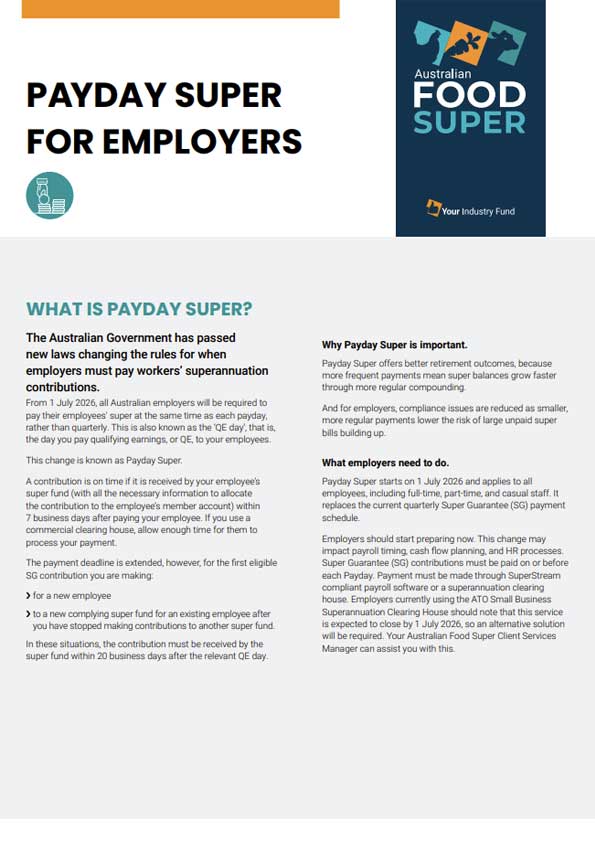
Download the Fact Sheet
Payday Super for Employers
If you require any assistance, or would like a printed copy of this or any fact sheet, please contact the Member Hotline on 1800 808 614